User blogs
Tag Search
Tags

Verzeichnis
Ein Branchenauflistung ist eine erstellte Liste von Websites. Solche Auflistungen, die ebenfalls als Themenregister weitverbreitet sind, offerieren eine arrangierte Methode zum Auffinden von Seiten im Web!

TERMINAL OPERATIONS
In 2008 Malcolm Rail became the Terminal Operator of the Daventry International Railfreight Terminal - DIRFT. Malcolm Rail partners with ProLogis who have invested jointly in the DIRFT rail operation.Get more news about Juk Rail Terminal,you can vist our website!
DIRFT is a 24/7 location and currently handles over 100 train services per week, for major freight operating companies such as DB Cargo, Direct Rail Services, and Freightliner.
DIRFT was born as an international rail hub, and today continues to handle several European services. The UK coverage offered by rail services handled through DIRFT allows users to hub core flows, for example connecting Europe to Scotland with minimal delay and removing the need to serve each destination with separate services when volume may not make it viable.
Current container lifting volumes are around 130,000 units per annum, handled by a modern fleet of reachstackers. DIRFT offers secure loaded and empty container storage. It is also open to hauliers for transfer lifts and short term container storage.
DIRFT is proud to have some of the worlds largest shipping lines, retailers and manufacturers as its customer base. We fulfil their bespoke requirements, including reporting to provide added value over the basic terminal product.
Alongside our high performing rail logistics service, we are also proud to offer one of the highest departure performance levels of any UK inland intermodal terminal, this is achieved by working together with Network Rail, connected terminals, and users of the train.
Our integrated Container Terminal Management System handles all Rail Terminal and Container activities throughout the UK. In addition to greatly enhancing our operational systems, the system provides valuable management information which is used to increase our operational efficiency.
Best Hunting Rangefinder Reviews : Top Picks for the Money in 2022
So you missed a buck or two last hunting season and you swear you don't want a repeat performance this year.If only you guessed its distance right by using one of the best hunting rangefinders below, you wouldn't have driven home with an empty truck bed.Get more news about Yard rangefinder Hunting,you can vist our website!
Whether you're a newbie to sports optics or you're upgrading your old pal for a new one, a range finder is a must-have for hunters.Thinking it's an unnecessary splurge? Once you incorporate optics into your hunt, you won't ever think that again.
But, where do you start and which is the best hunting rangefinder? That really depends on the type of hunting you are planning on doing and the budget you have to spend.
How to Choose a Rangefinder for Hunting
Your choice of range finder should be greatly influenced by the type of activity you plan to use it for. Are you a bow hunter, rifle hunter, or a bit of both? Do you see it getting the most use at the shooting range, archery range or out in the wilderness?
Once you answer these questions, you can begin to narrow down your options a lot – and we are here to help.
We have hunted the sports optics realm to find the best distance finding devices for a range of hunting/shooting activities, and those are the lists you see below. This is a great place to start as you will see the devices that are the top-rated rangefinders for your activity of choice.
Being a clever shopper means making the most of your budget to get the best of what you can possibly afford. But what can you afford? Every hunter’s budget is different so we have focused on a few price categories to provide options that will suit most budgets.
From low-cost champs to higher-priced prince’s, there is a hunting rangefinder to suit your needs in the groups below.
Top 6 Best Rifle Hunting Rangefinders in 2022
Rifle hunting takes you to where the wild things are, and you need to be prepared for all types of weather, terrain, and distance.
The best rifle hunting optics are going to be waterproof for that unpredictable weather. They are going to be your eyes, and so will need some serious long-distance yardage as well as the ability to constantly track your prey.
1. Vortex Optics Ranger 1800 Rangefinder
The Vortex Ranger 1800 is a beauty of a rangefinder. You might think its price is high, but it's very deserving of it. We even say it might be too cheap for its quality. However, we hunters have always been able to depend on Vortex for the best prices possible for the highest quality possible.
2. Leica Geovid R 10x42
You’ll need to budget over $1000 if you’re serious about high-performing rangefinder binoculars. One that falls into budget is the Geovid R. It’s scaled-down somewhat to provide a decent price, but it ain’t scaled-down when it comes to performance.
3. Vortex Razor HD 4000
This rangefinder is not only a Vortex, but it’s also a flagship Razor HD unit with 4000-yard ranging performance. In all truth, it just doesn’t get better than this.It’s clear that when you need extended distances, you’ll need to mount your magnified optic. While many have acquired extreme distances free-hand, you’ll need a tripod for accurate 4000-yard and beyond performance.
4. Leupold RX-1600i TBR/W with DNA Rangefinder
Today's price for high-end ballistic rangefinder technology doesn't cost nearly as close to what it used to a couple of years ago. Leupold underscores this point with the RX1600i rangefinder with TBR (True Ballistic Range) and DNA (Digitally eNhanced Accuracy) that comes in under $500.
5. Vortex Fury HD 5000 10x42
It might very well be naïve to think a ranging bino can actually range out this far. But what if it’s the best, most advanced laser rangefinder binoculars the market has ever seen? In our technological day, it’s possible. We can thank Vortex for showing us that it is.
6. Sig Sauer Kilo 1400 BDX
High-end technology doesn't get cheaper than this. Sig Sauer changes the rules when it comes to quality expectations and high prices. The Kilo 1400 slashes half the cost and yet delivers premium features like no other brand can do.
MEDAL WALL DISPLAYS
Turn your running awards into a work of art with a steel race medal wall hanger for runners from Gone For a Run. These steel displays serve as the perfect piece to showcase all your running achievements in one beautiful wall hanging display. You've put countless hours and miles into your training and you have the race medals to prove it. Your ribbons and awards are reminders of your achievements, therefore they shouldn’t be buried in a drawer. Put them out as a visual reminder of just how far you've come on your running journey. Our lovely steel medal hangers are hand-forged and laser-cut to include unique, running-inspired designs.Get more news about Metal Medal,you can vist our website!
Gone For a Run steel metal running award hangers come in three different sizes. The smallest can hold up to six running medals for runners who prefer to display only their most important awards. If you'd like to display more running medals, the standard-sized metal display holds up to 24. Finally, for the most prolific racers, we also carry medal displays that hold up to as many as 96 awards. It couldn't be easier to slip your race medal ribbons onto the display bar. Then, attach your metal hanger to the wall using reinforced screws. Extension bars, medal ribbon clips, and wall anchors are all optional add-ons that you can choose upon placing your order. These award display accessories can help add more space as well as improve the look and stability of your running medal hanger.
Our Gone For A Run laser-cut race medal wall hangers feature various illustrations and mantras inspired by running. The steel medal hangers are powder-coated to give them a silky finish and added durability. If you'd like to display your medals from races of a certain distance, our steel medal hanger distance collection is perfect for you; it features triathlon, half marathon, and marathon distances. Other designs include running quotes, run mantras, and runner girl medal hangers.
Amorphous & Nanocrystalline
Metglas® is an amorphous metal, Amorphous metals do not have crystalline structure like other magnetic materials. All the atoms in an amorphous metal are randomly arranged, thus giving it a higher resistivity (about three times) value than that for crystalline counterparts. Amorphous alloys are prepared by cooling the melt at about million degrees per second. This fast cooling does not give the atoms enough time to rearrange into stable crystalline form. As a result one gets metastable amorphous structure. Because of the absence of crystalline structure amorphous alloys are magnetically soft (lower coercivity, lower core loss, higher permeability). High resistivity gives lower loss at higher frequencies. The losses are among the lowest of any known magnetic materials.Get more news about Nanocrystalline core,you can vist our website!
Nanocrystalline or Finemet® Nanocrystalline - The precursor of FINEMET® Nanocrystalline is amorphous ribbon (non-crystalline) obtained by rapid quenching at one million °C/second from the molten metal consisting of Fe, Si, B and small amounts of Cu and Nb. These crystallized alloys have grains which are extremely uniform and small, "about ten nanometers in size". Amorphous metals which contain certain alloy elements show superior soft magnetic properties through crystallization. It was commonly known that the characteristics of soft magnetic materials are "larger crystal grains yield better soft magnetic properties". Contrary to this common belief, soft magnetic material consisting of a small, "nano-order", crystal grains have excellent soft magnetic properties.
It is well known that the higher CT core permeability, the lower measurement error & higher measurement accuracy. The silicon steel CT core can’t meet measurement accuracy under the situation of low Ampere-tums or small turn ratios. And the Fe-Ni Permalloy core’s application are limited because of their low Saturate induction and high cost. Nano-crystalline cores are getting wider usage for the 0.2,0.2s, 0.1 accuracy grade precious current transformers because of its high permeability, high magnetization and lower cost in the field of power supply systems, power energy measurement and controlling systems, dynamical system, relay protection, etc.
Silicone Brush Manufacturer: 7 Silicone Bristle Brushes Popular In Our Daily Life
As a silicone products manufacturer in China, HB Silicone specializes in developing and manufacturing a wide range of high-end consumer and healthcare silicone products.Get more news about Silicone Brush,you can vist our website!
During the past 12 years, we had gained extensive silicone product development experience and can help customers with silicone material selection, product design, tool mold design, and manufacturing.
One of the most produced products series is silicone brushes, we had designed and developed various kinds of custom silicone bristle brushes for kitchen and healthcare applications. We can be your trusted silicone brush manufacturer, we can customize your brushes in brush length, bristle density, length, and stillness as you required.
In this post, we are going to show you the silicone brushes we had made before. Let’s start.
1. Magic Silicone scrubbing gloves-dish washing gloves
It is a kitchen glove with a sponge or sponge with a glove, an all-in-one for dishwashing. Easy and multifunctional sponge glove. It is 100% SILICONE material with ultra-fine brushes. The palm and fingertips are covered with dense, long, and soft bristles, which can help to create more foam for deep cleaning. The gloves keep your hands dry and chemical-free. You can use them for dishwashing, kitchen cleaning, pet washing, etc.
2. Silicone dishwashing sponge
The silicone sponge with soft bristles on both sides provides a gentle scrub and will not cause scratches to your tableware. Made in FDA food-grade silicone, you can use it to wash fruit and vegetable.
It can also serve as a heat-proof mat. Silicone sponge drys quickly, it won’t contain bacteria and get mold. It is a much more hygienic alternative than a traditional sponge or cloth.
3. Silicone basting & pastry brush
The silicone basting brush is built to coat food with more flavor. You can use it for oil, melted butter, marinades, and sauce directly to foods on your grill. The dense, long bristles gain high performance in holding and retaining oil, butter, and sauce. The basting brush is heat resistant, you can use it on the hot grill.
4. Silicone bottle cleaning brush
The silicone bottle brush is designed with a long handle, the best fit for these deep, narrow-neck bottles such as baby bottles, and flower vases.
With 360-degree long flexible bristles, it can get deep down into the bottles to scrub away stubborn grime in every corner, and leave your bottles completely scratch-free. Works perfect for cleaning out the hydro flask too.
5. Silicone bath scrubbing brush/sponge
It’s two-side designed bath scrubbing brushes, one side with long, dense soft bristles provides deep and nicely clean. The bumpy nubs on the other side are excellent for lymphatic massage, improving blood circulation as well as scrubbing dirt from the skin.
6. Silicone face brush/ facial cleaning brush
Facial cleaning brushes have super tiny soft bristles, they can remove make-up, pore-clogging sunscreen, blackheads, and grime on your skin. Help to soften the skin, promote facial blood circulation, and improve skin absorption of the cream. Electic facial cleanser brushes are extremely popular today.
7. Silicone toothbrush
The U-shape silicone toothbrush is designed to free your hands when you are brushing your teeth. The U-shape design makes it fit the mouth shape. There are 4 layers of slopping soft bristle on both sides, they offer a full clean of tooth surface and interior.
The above are 7 examples of silicone brushes we ever produced. They are very useful and widely applied in our daily life. The bristles length, stiffness and density are core values we should pay much attention to, as they determine the tool mold design and process, as well as the production feasibility.
Linkverzeichnis
Ein Linkverzeichnis ist eine handgefertigte Liste von Webseiten. Diese Auflistungen, welche auch als Branchenregister weitverbreitet sind, gewähren eine arrangierte Art zum Auffinden von Webseiten!
Air Actuated Ball Valves
The ABVA requires a 4-way air solenoid valve(Part # 8345G1), and ABVS requires a 3-way air solenoidvalve (Part # 8320G13) to control actuation. Compressed airshould be filtered and lubricated. The hex nuts used to mountthe actuator are tapped to facilitate piping support.Get more news aboutpneumatic actuated valve,you can vist our website!
A 3/4" ball valve in Geon® PVC with Viton® seals and BSP threaded connections will be used as an example. The part number, as shown below, would be ABVA075XVT-PV. If this used standard NPT threads, the X would be left out of the part number. If the valve is to be ordered with a "Fail-Safe" (spring return) actuator, change ABVA to ABVS in the part number prefix. All of the possible permutations are shown under the part number in the table below.
Hyvair’s pneumatic actuated ball valves are available in three actuator sizes designed to accept multiple ball valve types from 1/2” to 2”. Actuators are stocked in double acting and spring return option with high torque ratings. Air pilot spool type valves are available in five sizes with several spool type options; with standard and Namur mounting. Hyvair’s poppet type valves are available with air or solenoid actuation, and stocked with 1/2” and 3/4” NPT porting.
Control valves need actuators to operate. This tutorial briefly discusses the differences between electric and pneumatic actuators, the relationship between direct acting and reverse acting terminology, and how this affects a valve's controlling influence. The importance of positioners is discussed with regard to what they do and why they are required for many applications.
One form of controlling device, the control valve, has now been covered. The actuator is the next logical area of interest.
The operation of a control valve involves positioning its movable part (the plug, ball or vane) relative to the stationary seat of the valve. The purpose of the valve actuator is to accurately locate the valve plug in a position dictated by the control signal.
The actuator accepts a signal from the control system and, in response, moves the valve to a fully-open or fully-closed position, or a more open or a more closed position (depending on whether ‘on/off’ or ‘continuous’ control action is used).
Piston actuators
Piston actuators are generally used where the stroke of a diaphragm actuator would be too short or the thrust is too small. The compressed air is applied to a solid piston contained within a solid cylinder. Piston actuators can be single acting or double acting, can withstand higher input pressures and can offer smaller cylinder volumes, which can act at high speed.
Diaphragm actuators
Diaphragm actuators have compressed air applied to a flexible membrane called the diaphragm. Figure 6.6.2 shows a rolling diaphragm where the effective diaphragm area is virtually constant throughout the actuator stroke. These types of actuators are single acting, in that air is only supplied to one side of the diaphragm, and they can be either direct acting (spring-to-retract) or reverse acting (spring-to-extend).
The Fifth Element Stones Pillar Candle Holders
Anyone who's ever seen my work knows I'm a sucker for all things nerdy. My home is, quite literally, a shrine to all of my favorite movies, TV shows, even games. Over the years, I've recreated hundreds of props for friends to use in their cosplay at the local Comicon, which can be extremely satisfying when you see how these props can pull a costume together.Get more news about elements candle holder,you can vist our website!
By far, though, my favorite time waster is making display props from hit movies that didn't indulge in merchandising for various reasons, or that whatever merchandise they did create is so rare and obscure as to make it unattainable to the average person. One big stipulation, that I have, is that the props I make need to have form and function. Meaning that, it either has to operate in the same way as it does in the franchise, or it must serve some other practical function besides being a simple display item.
In my top ten list of movies is the film 'The Fifth Element'. Beyond being an amazing film, props and merchandise are extremely difficult to find, and often if you do find something its either an expensive film prop that is profoundly expensive, or a low quality (and equally expensive) representation that can only be bought from specialty sites.
For my project, I wanted to recreate the element stones that were used to kill the 'evil' in the weapon chamber in Egypt. It was evident that the movie versions were made out of polystyrene, but I wanted mine to be a bit more durable and long lasting, and so I ended up manufacturing them out of wood. Also, following my own rules on prop creation, I decided to turn them into functional pillar candle holders that I could use to decorate my dinner table during gatherings, as a conversation piece, or simply as an everyday accent.
One of the problems with creating large triangular blocks is that you need large round blades to cut them properly, and unfortunately my table saw has limitations. The movie version is roughly 9" tall and 4" on each side with a .5" bevel, but because of these limitations, I ended up reducing the sides to 3", with a .5" bevel, though I was able to maintain the 9" length. This turned out to be a bit of a blessing, however, since as a table decoration, their larger size wouldn't have been practical and would have taken up too much space to be usable. If, indeed, you wanted to make perfectly sized 'stones', you can use all of the same techniques outlined in this instructable without much alteration. I'll make notes on the appropriate steps for anyone wanting to make the full size version.
Effectiveness of hemostatic agents in thyroid surgery for the prevention of postoperative bleeding
Postoperative bleeding remains one of the most frequent, but rarely life-threatening complications in thyroid surgery. Although arterial bleeding is the main cause of postoperative hemorrhage, most often no actively bleeding vessel can be found during revision. Therefore, the coagulation technique for larger vessels may play a minor role, and hemostatic agents could be of higher importance. In this descriptive, retrospective study, data of 279 patients with thyroid surgery (total of 414 thyroid lobectomies) were collected. We reviewed the electronic medical record by analyzing the histological, operative, laboratory and discharge reports in regards to postoperative bleeding. Of the 414 operated thyroid lobes, 2.4% (n = 10) bled. 1.4% (n = 6) needed reoperation while the other 1.0% (n = 4) could be treated conservatively. Hemostatic patches were applied 286 (69.1%) times. Of the 128 (30.9%) patch-free operated sides, 4.7% (n = 6) suffered postoperative bleeding. Tachosil® alone was used 211 (51.0%) times and bleeding occurred in 1.4% (n = 3). Without statistical significance (p = 0.08) the use of Tachosil® seems to help preventing postoperative bleeding. The combination with other patches doesn’t appear to be more efficient.To get more news abouthemostasis, you can visit rusuntacmed.com official website.
Due to its endocrine function, the thyroid gland is a well perfused organ. For this reason, a good hemostasis during surgical procedures is of utmost importance. Postoperative bleeding remains one of the most frequent complications, and can cause airway compression and respiratory distress in severe cases. Moreover, intraoperative bleeding can obscure important structures like the parathyroid glands and the recurrent laryngeal nerve, complicating surgical dissection and increasing morbidity Aleksandar, et al.1,2,3. The frequency of postoperative cervical hematoma (PCH) in thyroid surgery requiring reoperation ranges from 0 to 9.1%4, and it is the most common reason for return to the operating room5.
Many factors influence perioperative hemostasis. In the literature, several preoperative patient’s risk factors are described, such as Grave’s disease6,7,8,9, benign pathology6,8,9, the use of anticoagulation or antiplatelet medication while doing surgery6,10, an increased size of the pathology specimen6, an emergent admission8, presence of 2 or more comorbidities8, previous thyroid surgery9, age 65 years and older7,11, African-American race7 and history of alcohol abuse7. A BMI greater than 30 kg/m2 11,12 and male sex7,9,11 are also independent risk factors associated with PCH. Furthermore, postoperative hypertension increases the risk of postoperative bleeding9,13.
In the past century, the only instruments at a surgeon’s disposal to obliterate vessels were needle and thread in order to create a ligation. Nowadays, the industry provides a variety of devices to seal and cut vessels, such as metal clips, bipolar coagulation forceps (e.g. BiClamp®) and ultrasound scissors. The type of sealing technique doesn’t seem to affect the risk of postoperative bleeding. Alesina et al. and Brzezinski et al. found no difference in complication rate by using BiClamp® or ligations in their studies. Other vessel sealing systems, like LigaSure® and Harmonic Scalpel® have proven to be efficient in safely sealing the vessels with minimal thermal effect on the surrounding tissue, but they are expensive and only meant for a single use14,15. On the other hand, many studies such as the one from McNally et al. showed no difference in comparing ultrasonic dissection devices (Harmonic Focus®) with electronic vessel sealing systems (LigaSure®) in several criteria except from operating time, which was shorter for ultrasonic devices16.
Although arterial bleeding is the main cause of postoperative hemorrhage, as it starts earlier than venous oozing. Most often no actively bleeding vessel can be found during reoperation12. Therefore, the coagulation technique for the larger vessel may play a minor role. As certain conditions, like for example the need of anticoagulant agents cannot be changed for different reasons, hemostatic agents may play an important role. Therefore, we focused on sealant patches.
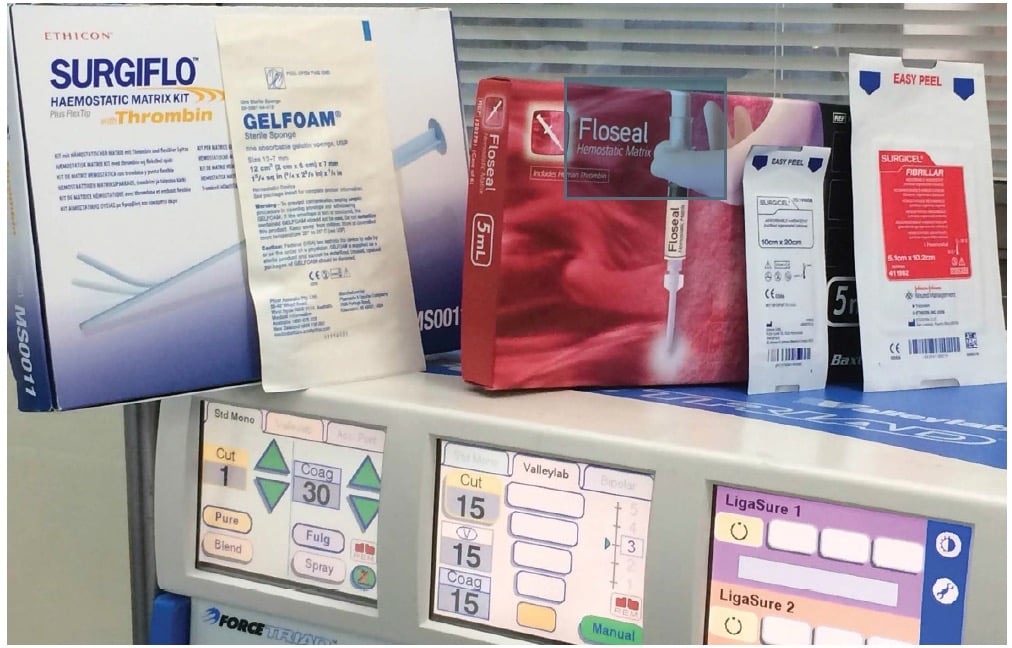
Basically, there are two main categories of hemostatic patches available: biologically active and physical agents. The first group consists of sealant matrixes containing human coagulation factors as a coating on the surface. In contact with body fluids, such as blood, the components of the coating diffuse into the wound activating the fibrinogen-thrombin reaction, thus initiating the last phase of the human coagulation cascade. This process leads to the formation of a fibrin clot, which holds the collagen matrix to the wound surface, creating a mechanically stable network that provides sealing. Among the commercially available products are Surgiflo®, Floseal® (gelatin-thrombin matrix sealants), Evarrest® and Tachosil® (fibrinogen and thrombin coated matrix), the latter being most frequently used at the University Hospital of Basel (USB). The second group consists of physical agents that enhance hemostasis using a passive substrate. An oxidized cellulose patch, when saturated with blood, provides a surface for platelet adhesion and aggregation, thus initiating the formation of a durable clot that doesn’t wash away or bleed again when irrigated. Tabotamp Snow®, Spongostan™ and Nu-Knit® are examples that belong to this type of physical agents.