User blogs
Tag Search
Tags

 More than 70 volunteers attended the June 15 assembly party, and in two and a half hours they helped assemble and recertify about 1,300 first aid kits.
“It’s a really big job, as we’re talking thousands of kits that need to be certified every month. We are the only recertifying facility for the entire area of operations,” said Tech Sgt. Joseph Gill, NCO in charge of warehouse medical logistics for the 379th Expeditionary Medical Support Squadron. “The need for the kits is always there and has been increasing as we’re seeing more people forward deployed.”
Gill added that Team AUAB is also now receiving and assembling the new Joint First Aid Kits for employment down range.
The new JFAK will be used by all services across the Department of Defense and is designed to fit with the Modular Lightweight Load-carrying Equipment-style protective gear. The new kit has a five-year shelf life and has all of its components individually compartmentalized inside. Two tourniquets are attached on the outside of the kit for quick access.
Gill said the new kits need only to be checked, the tourniquets attached and then tagged. To be sure not to mix parts or processes, Gill holds separate assembly parties depending on how many of the new kits are received.
Gill said there was no way his small staff could process the volume of kits required every month on their own.
“If it were not for our volunteers, we simply would not be able to take care of our service members. They [the volunteers] show up every month and pitch in to get the job done,” he said.
The current Air Force-specific Individual First Aid Kits have a shelf-life of three years. The kits have two vacuum-sealed packages with various first aid components. Every month, the kits need to be recertified by replacing items that have expired with newer ones to bring the kits into compliance for another year.
“It is a unique situation here because we are the hub for the entire AOR and we process a huge volume of kits,” said Tech Sgt. Jennifer Lotan, also from the 379th Expeditionary Medical Support Squadron. “I haven’t seen something like this before where so many people come to help out. It’s pretty impressive.”
Staff Sgt. Timothy Byrd, 379th Expeditionary Maintenance Squadron, has attended a couple parties and said he appreciates the community support.
“I’ve been deployed before to Afghanistan and Jordan, so I know the necessity of having a first aid kit on your person,” he said. “I never gave much thought as to how they were put together, so when I heard they needed help in assembling the kits, I was happy to help out.”
Local Command Sponsorship Program military spouses come regularly to the parties, finding it a good way to give back to the community and build relationships with the deployed service members who attend. They also bring home-baked treats to share with all the volunteers.
“It’s a good opportunity to be able to do something to help support the service members,” said Melissa James, spouse of Brig. Gen. Darren James, commander, 379th Air Expeditionary Wing. “We’re a small group of spouses here, and it’s a different situation for us than being stationed stateside. So this is just a wonderful way for us to help out and to meet and talk with the military folks. I love the social aspect of it. It’s a fun time and for a good cause.”
More than 70 volunteers attended the June 15 assembly party, and in two and a half hours they helped assemble and recertify about 1,300 first aid kits.
“It’s a really big job, as we’re talking thousands of kits that need to be certified every month. We are the only recertifying facility for the entire area of operations,” said Tech Sgt. Joseph Gill, NCO in charge of warehouse medical logistics for the 379th Expeditionary Medical Support Squadron. “The need for the kits is always there and has been increasing as we’re seeing more people forward deployed.”
Gill added that Team AUAB is also now receiving and assembling the new Joint First Aid Kits for employment down range.
The new JFAK will be used by all services across the Department of Defense and is designed to fit with the Modular Lightweight Load-carrying Equipment-style protective gear. The new kit has a five-year shelf life and has all of its components individually compartmentalized inside. Two tourniquets are attached on the outside of the kit for quick access.
Gill said the new kits need only to be checked, the tourniquets attached and then tagged. To be sure not to mix parts or processes, Gill holds separate assembly parties depending on how many of the new kits are received.
Gill said there was no way his small staff could process the volume of kits required every month on their own.
“If it were not for our volunteers, we simply would not be able to take care of our service members. They [the volunteers] show up every month and pitch in to get the job done,” he said.
The current Air Force-specific Individual First Aid Kits have a shelf-life of three years. The kits have two vacuum-sealed packages with various first aid components. Every month, the kits need to be recertified by replacing items that have expired with newer ones to bring the kits into compliance for another year.
“It is a unique situation here because we are the hub for the entire AOR and we process a huge volume of kits,” said Tech Sgt. Jennifer Lotan, also from the 379th Expeditionary Medical Support Squadron. “I haven’t seen something like this before where so many people come to help out. It’s pretty impressive.”
Staff Sgt. Timothy Byrd, 379th Expeditionary Maintenance Squadron, has attended a couple parties and said he appreciates the community support.
“I’ve been deployed before to Afghanistan and Jordan, so I know the necessity of having a first aid kit on your person,” he said. “I never gave much thought as to how they were put together, so when I heard they needed help in assembling the kits, I was happy to help out.”
Local Command Sponsorship Program military spouses come regularly to the parties, finding it a good way to give back to the community and build relationships with the deployed service members who attend. They also bring home-baked treats to share with all the volunteers.
“It’s a good opportunity to be able to do something to help support the service members,” said Melissa James, spouse of Brig. Gen. Darren James, commander, 379th Air Expeditionary Wing. “We’re a small group of spouses here, and it’s a different situation for us than being stationed stateside. So this is just a wonderful way for us to help out and to meet and talk with the military folks. I love the social aspect of it. It’s a fun time and for a good cause.”
 NETZSCH PumpsProgressing cavity pumps can handle higher pressures and higher viscosity materials than either rotary lobe or centrifugal pumps. Cost savings of up to 50 percent are possible with progressing cavity pumps over rotary lobe pumps, especially in smaller volume operations. The progressive cavity technology can also be designed with an open hopper that allows for the pumping of non-flowing products such as meats and vegetables. The choice in not so clear-cut for applications requiring an extremely small footprint; in these cases, designers must balance the need for the benefits achieved by use of progressing cavity pumps with available space to determine the best solution.
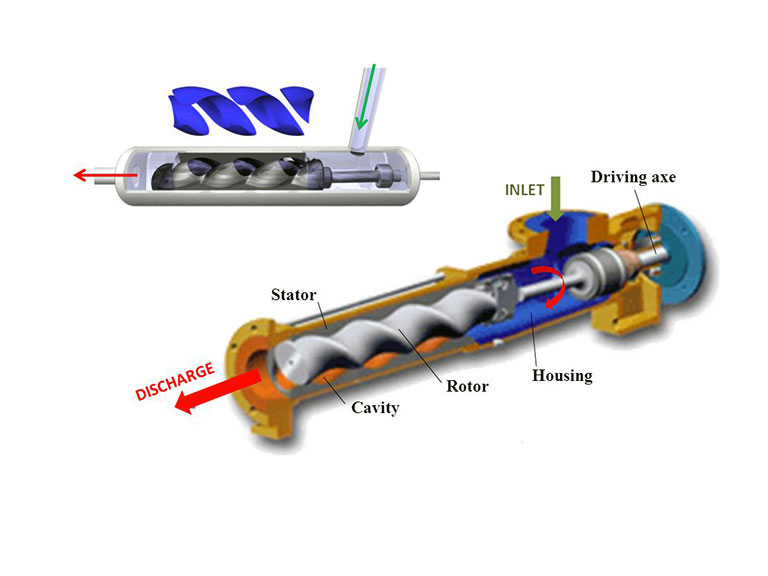
In the end, progressing cavity pumps are ideal for conveyance tasks in a number of food and beverage production environments, especially those with difficult-to-convey, shear-sensitive, abrasive, and/or viscous components. The pumping process in progressing cavity pumps involves a rotor turning with an eccentric rotary motion within a fixed stator. The two components are precisely geometrically mated with one another, conveying chambers are formed between them, and these chambers advance during rotation. The medium is gently transported in these chambers from the inlet to the discharge side by the turning motion. Volume and pressure remain constant with progressing cavity pump technology, regardless of the viscosity or consistency of the substance being conveyed. In addition, no shear forces, pulsation, or pressure reversal points occur, thus avoiding damage to the medium.
In food and beverage applications specifically, progressing cavity pumps must be designed to reduce the risk of contamination and help achieve the targets of the Food and Drug Administration’s (FDA’s) Food Safety Modernization Act (FSMA). To do so, pumps must use FDA- compliant materials, including metals, plastics, and elastomers, with each elastomer compound independently tested to determine suitability and be of a high hygienic design. Depending on the process and the industry, 3-A Sanitary Standards Inc. (3-A SSI) or European Hygienic Engineering and Design Group (EHEDG) certification may be required for pump systems and processes in food and beverage applications.
Making CIP work in PC/PD pumps
NETZSCH PumpsCIP procedures are critically important in food and beverage conveying applications because proper pump and pipe cleaning is key to avoiding contamination, bacterial growth, and other issues. By running a cleaning agent (acids and caustics) through the pump system, proper cleaning can be ensured and regulatory requirements met. It is important therefore to utilize the cleanest possible design within the pump to minimize cleaning time and maximize production time. A well designed CIP system can even be used to CIP open hopper pumps after pumping non flowing products.
Benefits of well-designed pumping technology
It is important to take cleaning into account when first designing the pumping system. The progressing cavity pump rotor should be designed to be compatible with both the process’s media and temperature range and the chemicals being used in the CIP process and their temperature. CIP processes can change, and when they do, compatibility with the stator elastomer should be verified and the stator or cleaning solution replaced if necessary.
Because a separate dedicated pump is used for CIP (usually a small low-cost centrifugal pump), progressing cavity pump design should include the appropriate bypass setup, to ensure that turbulent flow is achieved in both the pump and the piping downstream of the pump. The NETZSCH NEMO® Progressing Cavity Pump is a good example of this kind of design for sanitary applications. With suction and discharge ports located tangential to the body of the pump, the NEMO pumps achieve complete drainage and proper circulation through the pump for cleaning. In addition, NEMO pumps feature open hygienic joints to enable the best cleaning of the joint and the elimination of dead zones that can lead to contamination. NETZSCH with their NEMO Sanitary Plus design also offers flexible connecting rods in lieu of joints, negating any crevices and reducing CIP time even further.
Due to the closed system and the few existing leakage points, flaring in fields is prevented. The highest standards for equipment and safety are an essential requirement for working in oil fields to keep processes safe and reliable. NEMO® pumps contribute to this safety and reliability. The complexity of the pumped media ranges from high viscosity to low viscosity, from shear sensitive to heavily loaded with solids. The innovative and reliable design allows for efficient process control. These multiphase pumps meet the requirements of API 676 3rd Edition and also those of NACE MR-0-175. Safe and reliable pumping with maximum efficiency, NEMO® Multiphase progressing cavity pumps make it possible.
NETZSCH PumpsProgressing cavity pumps can handle higher pressures and higher viscosity materials than either rotary lobe or centrifugal pumps. Cost savings of up to 50 percent are possible with progressing cavity pumps over rotary lobe pumps, especially in smaller volume operations. The progressive cavity technology can also be designed with an open hopper that allows for the pumping of non-flowing products such as meats and vegetables. The choice in not so clear-cut for applications requiring an extremely small footprint; in these cases, designers must balance the need for the benefits achieved by use of progressing cavity pumps with available space to determine the best solution.
In the end, progressing cavity pumps are ideal for conveyance tasks in a number of food and beverage production environments, especially those with difficult-to-convey, shear-sensitive, abrasive, and/or viscous components. The pumping process in progressing cavity pumps involves a rotor turning with an eccentric rotary motion within a fixed stator. The two components are precisely geometrically mated with one another, conveying chambers are formed between them, and these chambers advance during rotation. The medium is gently transported in these chambers from the inlet to the discharge side by the turning motion. Volume and pressure remain constant with progressing cavity pump technology, regardless of the viscosity or consistency of the substance being conveyed. In addition, no shear forces, pulsation, or pressure reversal points occur, thus avoiding damage to the medium.
In food and beverage applications specifically, progressing cavity pumps must be designed to reduce the risk of contamination and help achieve the targets of the Food and Drug Administration’s (FDA’s) Food Safety Modernization Act (FSMA). To do so, pumps must use FDA- compliant materials, including metals, plastics, and elastomers, with each elastomer compound independently tested to determine suitability and be of a high hygienic design. Depending on the process and the industry, 3-A Sanitary Standards Inc. (3-A SSI) or European Hygienic Engineering and Design Group (EHEDG) certification may be required for pump systems and processes in food and beverage applications.
Making CIP work in PC/PD pumps
NETZSCH PumpsCIP procedures are critically important in food and beverage conveying applications because proper pump and pipe cleaning is key to avoiding contamination, bacterial growth, and other issues. By running a cleaning agent (acids and caustics) through the pump system, proper cleaning can be ensured and regulatory requirements met. It is important therefore to utilize the cleanest possible design within the pump to minimize cleaning time and maximize production time. A well designed CIP system can even be used to CIP open hopper pumps after pumping non flowing products.
Benefits of well-designed pumping technology
It is important to take cleaning into account when first designing the pumping system. The progressing cavity pump rotor should be designed to be compatible with both the process’s media and temperature range and the chemicals being used in the CIP process and their temperature. CIP processes can change, and when they do, compatibility with the stator elastomer should be verified and the stator or cleaning solution replaced if necessary.
Because a separate dedicated pump is used for CIP (usually a small low-cost centrifugal pump), progressing cavity pump design should include the appropriate bypass setup, to ensure that turbulent flow is achieved in both the pump and the piping downstream of the pump. The NETZSCH NEMO® Progressing Cavity Pump is a good example of this kind of design for sanitary applications. With suction and discharge ports located tangential to the body of the pump, the NEMO pumps achieve complete drainage and proper circulation through the pump for cleaning. In addition, NEMO pumps feature open hygienic joints to enable the best cleaning of the joint and the elimination of dead zones that can lead to contamination. NETZSCH with their NEMO Sanitary Plus design also offers flexible connecting rods in lieu of joints, negating any crevices and reducing CIP time even further.
Due to the closed system and the few existing leakage points, flaring in fields is prevented. The highest standards for equipment and safety are an essential requirement for working in oil fields to keep processes safe and reliable. NEMO® pumps contribute to this safety and reliability. The complexity of the pumped media ranges from high viscosity to low viscosity, from shear sensitive to heavily loaded with solids. The innovative and reliable design allows for efficient process control. These multiphase pumps meet the requirements of API 676 3rd Edition and also those of NACE MR-0-175. Safe and reliable pumping with maximum efficiency, NEMO® Multiphase progressing cavity pumps make it possible.
 But what if a single piece of machinery could combine both rugged durability and smooth, agile productivity? As fate would have it, this type of versatility and precision actually exists, and it is embodied by the new Alfa Laval Twin Screw Pump.
TOP FEATURES AND FUNCTIONS:
What all can the versatile Twin Screw Pump do? Take a closer look at a few of its stand-out capabilities and learn why many food/beverage producers are buzzing about it.
THE FLEXIBILITY OF TWIN SCREW TECHNOLOGY
Although classified as a positive displacement pump, Alfa Laval’s Twin Screw can accomplish so much more. Unlike conventional positive displacement pumps which are primarily used for thick, viscous products, the new Twin Screw by Alfa Laval also has the ability to propel thin material like a centrifugal pump.
Gentle and virtually pulse-free, the Twin Screw is able to convey product through at various speeds for different viscosity liquids. This allows the pump to be utilized in a flexible manner within your production, adding significant value to producers with diverse ingredients, such as:
The Alfa Laval Twin Screw Pump is finely crafted with a hygienic, stainless-steel frame, profiled elastomers, and mechanical seals. Utilizing a robust gearbox design, the pump is calibrated to operate quietly, efficiently, and at a reduced temperature to enhance safety.
There are also very few wear items on the pump. Alfa Laval’s Twin Screw has the ability to run for a very long time and requires very little maintenance.
When maintenance is needed, there are plenty of reasons to appreciate this pump. Alfa Laval’s diligent design provides true front-loading access to the pump’s seal and timing gears for easy servicing.
TURBOMECHANICAL SPECIFICATIONS
Triro E-range can be supplied to meet most turbomechanical specifications and applications including API 614 and API 610 (where relevant to P.D. Pumps).
NON STANDARD PUMPS
Triro E-range can be factory modified for special applications and higher viscosities.
* Bespoke and custom designs available
UNITIZATION
Pumps can be supplied bareshaft or assembled with the driver in various arrangements including vertical tanktop, pedestal and baseplate options, with spacer or non-spacer couplings and non spark guards.
But what if a single piece of machinery could combine both rugged durability and smooth, agile productivity? As fate would have it, this type of versatility and precision actually exists, and it is embodied by the new Alfa Laval Twin Screw Pump.
TOP FEATURES AND FUNCTIONS:
What all can the versatile Twin Screw Pump do? Take a closer look at a few of its stand-out capabilities and learn why many food/beverage producers are buzzing about it.
THE FLEXIBILITY OF TWIN SCREW TECHNOLOGY
Although classified as a positive displacement pump, Alfa Laval’s Twin Screw can accomplish so much more. Unlike conventional positive displacement pumps which are primarily used for thick, viscous products, the new Twin Screw by Alfa Laval also has the ability to propel thin material like a centrifugal pump.
Gentle and virtually pulse-free, the Twin Screw is able to convey product through at various speeds for different viscosity liquids. This allows the pump to be utilized in a flexible manner within your production, adding significant value to producers with diverse ingredients, such as:
The Alfa Laval Twin Screw Pump is finely crafted with a hygienic, stainless-steel frame, profiled elastomers, and mechanical seals. Utilizing a robust gearbox design, the pump is calibrated to operate quietly, efficiently, and at a reduced temperature to enhance safety.
There are also very few wear items on the pump. Alfa Laval’s Twin Screw has the ability to run for a very long time and requires very little maintenance.
When maintenance is needed, there are plenty of reasons to appreciate this pump. Alfa Laval’s diligent design provides true front-loading access to the pump’s seal and timing gears for easy servicing.
TURBOMECHANICAL SPECIFICATIONS
Triro E-range can be supplied to meet most turbomechanical specifications and applications including API 614 and API 610 (where relevant to P.D. Pumps).
NON STANDARD PUMPS
Triro E-range can be factory modified for special applications and higher viscosities.
* Bespoke and custom designs available
UNITIZATION
Pumps can be supplied bareshaft or assembled with the driver in various arrangements including vertical tanktop, pedestal and baseplate options, with spacer or non-spacer couplings and non spark guards.
 Smart Door Lock Installation Cost by Lock Type
There are many kinds of smart locks, each with its own features and functionality. Some might require a steady internet or Bluetooth connection while others might need specific accessories to work.
Let’s take a look at different types of smart locks and their costs, excluding the labor cost of installing them:
Wi-Fi-Enabled Smart Lock
As the name implies, Wi-Fi smart locks work off a Wi-Fi connection and allow you to access and check your home security remotely. You can change codes, lock and unlock doors, or check if there’s a breach.
Wi-Fi-enabled smart door locks are compatible with all kinds of home systems, be it Amazon Alexa, Google Home, or Apple Siri, and operate with a phone app. Most designs do not need an adapter or additional hub to work. Excluding the installation costs, a Wi-Fi smart lock typically costs $200 to $300 per lock where cost varies with features, brand, etc.
Bluetooth Smart Door Lock
Bluetooth smart door lock systems come with almost the same features as a Wi-Fi-enabled smart lock. You can unlock and lock doors, set new codes, set auto locks, and unlock them remotely.
A basic Bluetooth smart lock unit costs around $170 to $260 and works with a mobile app. The only drawback of these smart locks is that they have a limited range of 40 to 50 feet.
RFID Smart Door Lock
Radio Frequency Identification, or RFID, wireless systems consist of two components: readers and tags. An RFID smart lock uses a keycard, just like locks in hotel rooms or offices. The system uses electromagnetic waves to transmit signals between the card and the lock. Contactless debit or credit card payments work on the same principle. So, no need to worry about forgetting your keys.
Some RFID lock models are completely contactless, while others require a physical connection between the lock pad and the card. You have the freedom to choose between a microchip card or a key fob-style access card according to your home security system and convenience.
Biometric Smart Door Lock
Biometric lock systems employ a combination of PINs and fingerprints to lock and unlock doors. They use a touchscreen design featuring biometric technology that scans and recognizes your fingerprint to unlock the door.
RFID, keypad, and smartphone app access are often integrated into these locks as backup methods. Many biometric lock models also work with smart home automation systems. Depending on the features and model you pick, biometric units generally cost $200 – $350.
Z-Wave Smart Door Lock
These smart locks use Z-Wave radio frequency technology to integrate with your smart home control system. You can program and control the lock with a smartphone app. Some models come with advanced features such as enhanced security inputs and automatic door locking, but they mostly need a hub or Alexa device to work. On average, locks with Z-wave capability cost $240 to $360.
Smart Door Lock Installation Cost by Lock Type
There are many kinds of smart locks, each with its own features and functionality. Some might require a steady internet or Bluetooth connection while others might need specific accessories to work.
Let’s take a look at different types of smart locks and their costs, excluding the labor cost of installing them:
Wi-Fi-Enabled Smart Lock
As the name implies, Wi-Fi smart locks work off a Wi-Fi connection and allow you to access and check your home security remotely. You can change codes, lock and unlock doors, or check if there’s a breach.
Wi-Fi-enabled smart door locks are compatible with all kinds of home systems, be it Amazon Alexa, Google Home, or Apple Siri, and operate with a phone app. Most designs do not need an adapter or additional hub to work. Excluding the installation costs, a Wi-Fi smart lock typically costs $200 to $300 per lock where cost varies with features, brand, etc.
Bluetooth Smart Door Lock
Bluetooth smart door lock systems come with almost the same features as a Wi-Fi-enabled smart lock. You can unlock and lock doors, set new codes, set auto locks, and unlock them remotely.
A basic Bluetooth smart lock unit costs around $170 to $260 and works with a mobile app. The only drawback of these smart locks is that they have a limited range of 40 to 50 feet.
RFID Smart Door Lock
Radio Frequency Identification, or RFID, wireless systems consist of two components: readers and tags. An RFID smart lock uses a keycard, just like locks in hotel rooms or offices. The system uses electromagnetic waves to transmit signals between the card and the lock. Contactless debit or credit card payments work on the same principle. So, no need to worry about forgetting your keys.
Some RFID lock models are completely contactless, while others require a physical connection between the lock pad and the card. You have the freedom to choose between a microchip card or a key fob-style access card according to your home security system and convenience.
Biometric Smart Door Lock
Biometric lock systems employ a combination of PINs and fingerprints to lock and unlock doors. They use a touchscreen design featuring biometric technology that scans and recognizes your fingerprint to unlock the door.
RFID, keypad, and smartphone app access are often integrated into these locks as backup methods. Many biometric lock models also work with smart home automation systems. Depending on the features and model you pick, biometric units generally cost $200 – $350.
Z-Wave Smart Door Lock
These smart locks use Z-Wave radio frequency technology to integrate with your smart home control system. You can program and control the lock with a smartphone app. Some models come with advanced features such as enhanced security inputs and automatic door locking, but they mostly need a hub or Alexa device to work. On average, locks with Z-wave capability cost $240 to $360.
 The perspective projection is used in cases where the three-dimensionality of an object needs to be rendered more realistically than isometric view allows. In perspective view lines that are parallel in nature appear to intersect in the projected image – for example, if railroads are shown in perspective view, they appear to converge to a single point called a vanishing point.
The perspective view is usually divided into one-point, two-point or three-point perspective, depending on the orientation of the projection plane with respect to the axes of the depicted object (see Fig. 1):
one-point – a 3D object is created using non-parallel lines converging at one point on the horizon;
two-point – shows the 3D object from the side, non-parallel lines converge at two points on the horizon;
three-point – it has two vanishing points on the horizon, but in addition to them it uses a third, vertical perspective point; a three-point perspective is closest to real perception.
1. Realism
The objects depicted in perspective projection look about the way we are used to seeing them in reality. This applies equally to rendering the external volume and internal space, the external and internal proportions of the object. Realism makes a perspective view a must in 3D CAD software.
2. Accurate representation of object locations
We can say that this is one of the factors that make the perspective view pretty realistic. Compared to isometric projection, which is great for conveying the simple shapes of a 3D model, but can be misleading as to the location of its individual parts, perspective projection gives a more accurate representation of the location of individual parts.
3 . The constancy of 3D
Unlike isometric view, perspective view clearly demonstrates the three-dimensionality of an object, even when looking at the object parallel to one of its axes (that is, at X=0, Y=0, or Z=0).
For example, if we look at Fig. 3, which shows a section of the facade in perspective view, then even with a strictly frontal view (X=0), we can judge the length of the building and the relative position of its internal elements (furniture, doors, etc.).
But as soon as we switch to isometric projection, the internal detail disappears and we get a flat image (Fig. 4).
The perspective projection is used in cases where the three-dimensionality of an object needs to be rendered more realistically than isometric view allows. In perspective view lines that are parallel in nature appear to intersect in the projected image – for example, if railroads are shown in perspective view, they appear to converge to a single point called a vanishing point.
The perspective view is usually divided into one-point, two-point or three-point perspective, depending on the orientation of the projection plane with respect to the axes of the depicted object (see Fig. 1):
one-point – a 3D object is created using non-parallel lines converging at one point on the horizon;
two-point – shows the 3D object from the side, non-parallel lines converge at two points on the horizon;
three-point – it has two vanishing points on the horizon, but in addition to them it uses a third, vertical perspective point; a three-point perspective is closest to real perception.
1. Realism
The objects depicted in perspective projection look about the way we are used to seeing them in reality. This applies equally to rendering the external volume and internal space, the external and internal proportions of the object. Realism makes a perspective view a must in 3D CAD software.
2. Accurate representation of object locations
We can say that this is one of the factors that make the perspective view pretty realistic. Compared to isometric projection, which is great for conveying the simple shapes of a 3D model, but can be misleading as to the location of its individual parts, perspective projection gives a more accurate representation of the location of individual parts.
3 . The constancy of 3D
Unlike isometric view, perspective view clearly demonstrates the three-dimensionality of an object, even when looking at the object parallel to one of its axes (that is, at X=0, Y=0, or Z=0).
For example, if we look at Fig. 3, which shows a section of the facade in perspective view, then even with a strictly frontal view (X=0), we can judge the length of the building and the relative position of its internal elements (furniture, doors, etc.).
But as soon as we switch to isometric projection, the internal detail disappears and we get a flat image (Fig. 4).


Several buyers are usually commencing to require a next examine any amount of money or perhaps micro-cap stocks and shares. With all the economic system coming out of economic depression, several analysts and also buyers are usually spending several attention to organizations in which endured financial meltdown over the last several years. Pleased simply by fresh supervision techniques, lowered credit card debt, and also improved profitability, these kinds of stocks and shares are usually will no longer the particular "rogue" investment structure they will once were.
These kinds of stocks and shares, also referred to as micro-cap stocks and shares, are usually stocks and shares traded over key swap regarding significantly less as compared to standard stocks and shares. They may be traded "over the particular counter" while using the cell phone or perhaps on the web investing program, with out a dealer. These kinds of stocks and shares typically business with lower than $5. 00 any discuss and so are not necessarily governed from the identical processing and also record procedures since a lot more standard stocks and shares. In case a inventory was outlined over a key swap, just like the Nyc Stock exchange, NADSQ or perhaps U . s . Stock exchange, the business must keep on having its quarterly filings.
The particular key fund web sites, just like MSN Funds, Bing Fund, and also CNBC usually are not committed any amount of money inventory web sites, nevertheless they carry out offer several information regarding these kinds of stocks and shares. Many times several information on organizations analysts feel are usually "on the particular bubble: " and also poised regarding principal supply enlargement. Sometimes, these kinds of web sites re also offering everyday signals since several "hot" stocks and shares. In case you are investing by means of a great on the web investing program, it's also possible to notice late rates and also record rates stock analysts for pfe. With regards to the amount of consumer and also consumer program made available from the program, you could or perhaps may well not have access to a broker or perhaps analysts' study.
In order to make an educated selection concerning investing the inventory you should perform several further study of a firm's credit card debt, profitability, liquidity, and also revenue quantities. There are a variety regarding inventory web sites, whichare specialized in supporting buyers find the proper inventory.
Analysts and also copy writers working for these kinds of web sites acquire countrywide investing styles and also experience these for your any amount of money wall street game. These kinds of committed inventory web sites offer everyday "hot sheets" filled up with projections and also methods for productive investing treatment. These kinds of web sites are usually up to date on a regular basis and possess one of the most committed any amount of money inventory articles. Any established trader will need the following pointers and also have used them being a bouncing away from level for very own self-sufficient and also self-sufficient study.
The greatest resources of the inventory web sites will be the chat rooms and also debate boards. Typically appropriated regarding associates and also clients simply, these kinds of on the web chats offer buyers with all the possiblity to understand together with and also coming from master buyers. Any amount of money inventory buyers can easily go over very hot suggestions and also styles between colleagues. Several web sites inspire buyers to create their particular portfolios, offering associates possibility to notice real time info, income, and also loss.